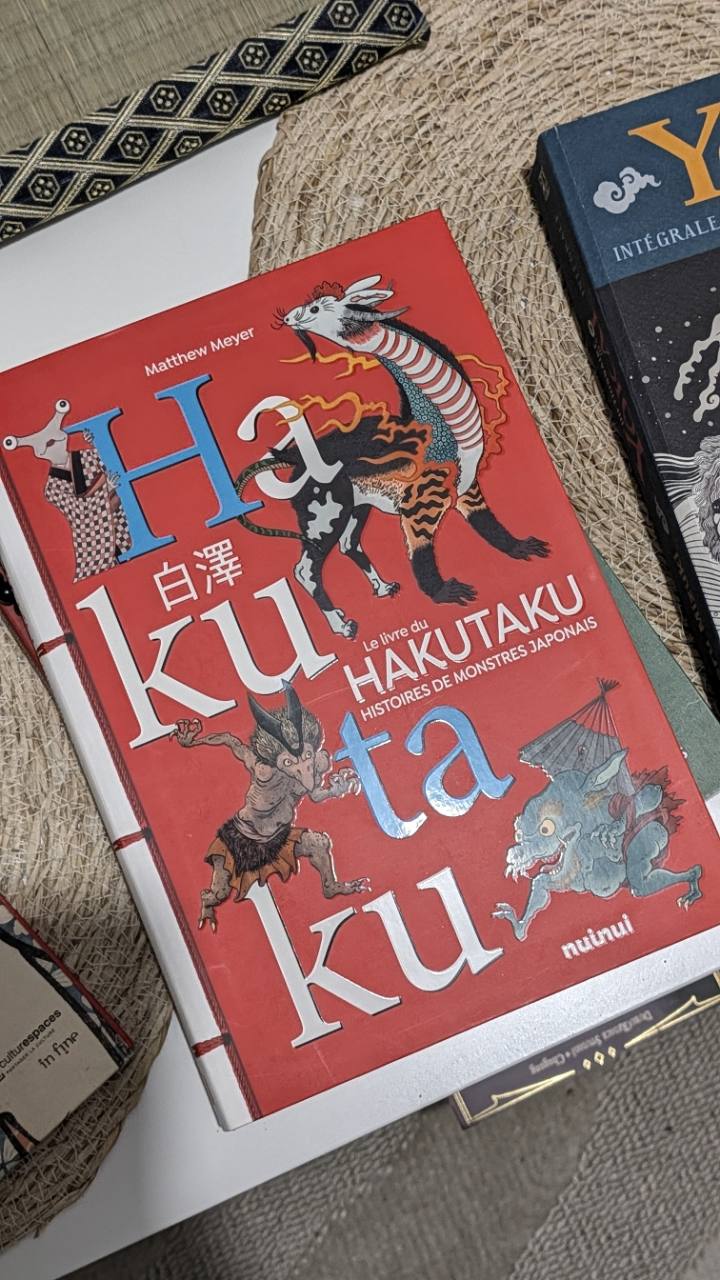
Matthew Meyer’s Le livre du Hakutaku. Histoires de monstres japonais is a book to consider if your interest in yōkai starts with their stories and representations. The copy from my shelf shown here is the French NuiNui edition. This article is in English; the featured volume is in French. Its project raises a useful question: how do different stories, images and traditions become a bestiary?
Why the name Hakutaku?
On his website, Meyer connects his title to the legend of an encyclopaedia given to an emperor by a marvellous creature. It was said to contain knowledge of supernatural beings. He uses this story to introduce a long practice of collecting information about the spirit world and giving it visual form.
The legend helps explain the project: a bestiary gathers and retells. The title does not make Meyer’s book the legendary encyclopaedia itself. It is a contemporary work situated within a history of collections about supernatural beings.
How stories become illustrated collections
Meyer describes artists drawing on several kinds of material, including tradition, literature, older accounts and stories reinterpreted across cultures. Some yōkai also emerged from wordplay or the concerns of a particular period. This approach invites you to consider how figures move between sources, alongside the question of what they look like.
The English original, The Book of the Hakutaku, appears in his bibliography under 2018. He describes it as a bestiary with more than a hundred illustrated entries. That description concerns his original book; the photograph here shows the French volume. Keeping both titles in view helps identify the project without merging the editions.
Read a being without fixing its story forever
One way into a bestiary is to separate three questions: how is the being described, what story is attached to it, and what origin does that story give it? A striking appearance catches attention, but it does not explain a figure’s entire history. Our guide to yōkai and Japanese folklore introduces some useful distinctions.
To continue exploring, note a name and the reference attached to an account, then follow that lead. When a precise historical question arises, the source’s context matters as much as the monster. This approach helps keep a transmitted story, a variant and a recent interpretation distinct.
Monsters and ghosts need different questions
Meyer’s introduction brings together monsters, spirits and ghosts. Our guide to Japanese yūrei gives more specific starting points for the last of those subjects. Supernatural terms do not all describe exactly the same thing. Keeping their differences visible is more useful than calling every figure a demon.
The book may suit someone interested in following stories and the ways they are presented. Identifying a particular artwork or establishing a date calls for additional references devoted to that work or period. A bestiary provides one route through the subject, with other sources helping to answer more specific questions.
The French volume shown here
This is Le livre du Hakutaku. Histoires de monstres japonais, by Matthew Meyer, published in French by NuiNui. The 2020 edition is recorded among the Villa Arson library’s acquisitions. The French title, author, publisher and language identify the selection featured here. Publication details belonging to the English original should not be assigned to this translation.
This edition is in French. I may earn a commission from this link. Find this edition on Amazon.fr (France).
Continue with another perspective
The yōkai books from my shelf also include a Mizuki dictionary and a book about Japanese prints. That selection suggests further directions depending on whether you want to explore a figure, a story or an image.
For another way of giving faces a physical form, explore the Dai Yokai Japanese masks, contemporary pieces prepared, painted and finished by hand in Brittany.
Sources
Matthew Meyer’s book introductions; Villa Arson, June 2021 acquisitions, page 3.