A samurai tattoo usually shows a warrior drawn from Japanese military tales and warrior prints. It can suggest courage, discipline or loyalty, but it has no single meaning. The character, the scene and the intent agreed with the tattoo artist decide how it reads.
The useful question is not "what does a samurai mean?" but "which warrior, in which story, and with which face?". Prints, armour and legends give precise answers.
Where do the samurai in Japanese tattooing come from?
Many of the warriors in Japanese tattooing come from musha-e, warrior prints. The JAANUS glossary defines them as ukiyo-e prints of battle scenes and heroic armoured warriors. Their subjects often come from military chronicles such as the Heike monogatari, the Genpei seisuiki or the Taiheiki.
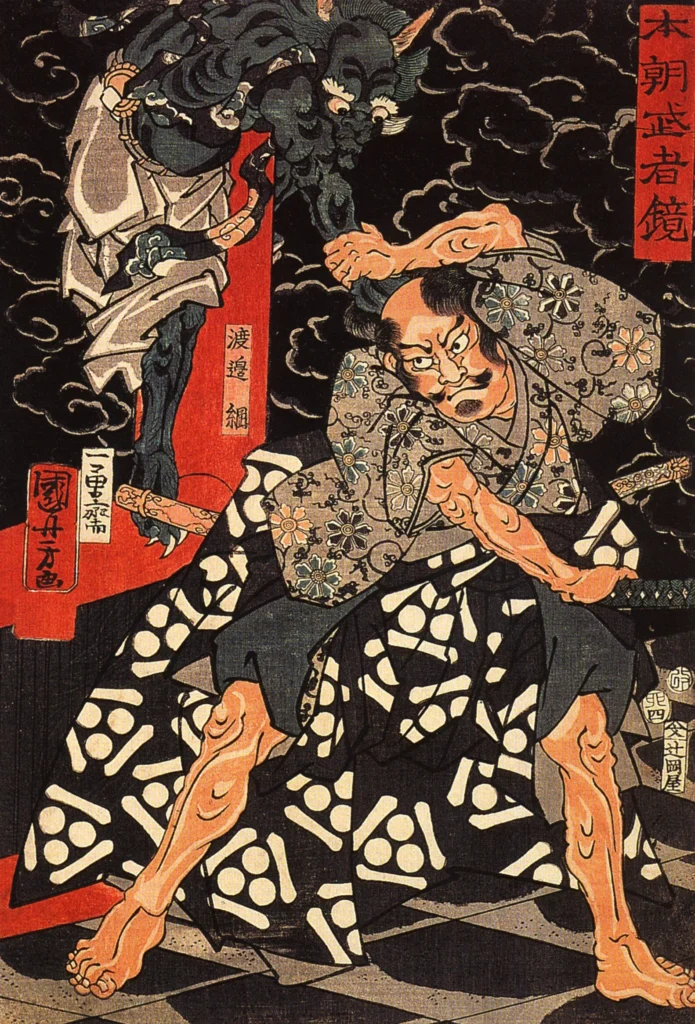
Utagawa Kuniyoshi took the genre to its peak and earned the nickname "Kuniyoshi of the Warrior Prints". His 1827 series on the heroes of the Suikoden was a major success in Edo. The Museum of Fine Arts, Boston explains that tattoo artists took inspiration from these prints, and that Kuniyoshi’s designs still circulate in studios worldwide.
One point deserves clarity: the Suikoden heroes are outlaws from a Chinese novel, not samurai. Kuniyoshi also drew many Japanese warriors, and those musha-e supply the samurai of today’s tattoos.
Were samurai tattooed?
The sources consulted for this article do not present samurai as wearers of large decorative tattoos. According to the Asian Art Museum in San Francisco, the designs born from prints adorned the bodies of Japanese townsmen, labourers and dandies alike. The same museum notes that kabuki actors were not tattooed: they wore painted tattoos or close-fitting garments imitating tattooed skin.
The samurai is therefore mainly a subject of tattooing. Wearing one today does not continue a warrior-class practice; it means choosing a heroic figure handed down through images. For the wider history, read the guide to the history of tattooing in Japan.
Which warriors appear in tattoos?
A generic armoured samurai can work, but a named character brings a scene and a logic for the composition. Several heroes of Japanese tales fight yōkai, which naturally links the warrior with a demon or an Oni.
| Warrior | Classic scene | Read more |
|---|---|---|
| Watanabe no Tsuna | He cuts off the arm of the demon Ibaraki-dōji | Watanabe no Tsuna |
| Minamoto no Raikō | Expedition against Shuten-dōji, the Oni chief of Mount Ōe | Shuten-dōji |
| Minamoto no Yoshitsune | Childhood on Mount Kurama, training with the tengu | The Tengu |
| Rōnin and Miyamoto Musashi | The masterless warrior, the duel, the 47 rōnin | Rōnin |
These stories are legends or embellished accounts, passed on through chronicles, theatre and prints. A tattoo can draw on them freely, as long as the scene is not presented as historical fact. The guide to samurai history and bushidō helps separate history from the romantic image.
Samurai and Oni mask: what does the pairing mean?
Japanese armour included face guards. The menpō covers the lower face, the sōmen the whole face. The Samurai Museum Berlin describes two main expression types: the ressei-men, "fierce face", and the ryūbu-men, with a nobler expression. The Penn Museum holds a ressei menpō whose metal creases create an aggressive expression.
These fierce masks explain the modern image of the samurai with a demonic face. In a tattoo, the menpō can become a horned, fanged Oni face. That is a contemporary interpretation: a historical menpō was not an Oni mask, even when it was meant to intimidate. The common reading today, the man behind the mask or the warrior’s darker side, belongs to the wearer and the tattoo artist. The menpō and samurai armour mask guide covers the historical types.

Composition: face alone, armoured warrior or battle scene
- Menpō, helmet or face alone: a compact format that reads well on a forearm, calf or upper arm. Keep the silhouette simple so it does not blur at a distance.
- Warrior in armour: needs a sleeve, thigh or back. Armour plates, cords and the sword add movement to the composition.
- Scene with a yōkai: Tsuna and Ibaraki, Raikō and Shuten-dōji. This is the format of large back pieces, with clouds, waves or flames in the background.
Whether to use a gakubori background is decided with the tattoo artist, according to the body and existing tattoos. The Oni mask tattoo guide explains these composition choices, and the irezumi motifs guide covers other subjects.
A half-mask as a volume reference
Japanese tattooing was one of my ways into Japanese culture. A physical object shows how light falls on the creases, teeth or nose of a mask from several angles. It is only a volume reference: drawing on skin remains the tattoo artist’s work.
The Mempo half-masks, such as the red samurai Mempo, are contemporary pieces. Their base is 3D printed in PETG, then sanded, painted and finished by hand in Brittany. They are not historical armour.
FAQ
What does a samurai tattoo mean?
It has no single meaning. It usually shows a warrior taken from military tales and warrior prints, and can suggest courage, discipline or a specific story. The character and scene matter more than a general meaning.
Were samurai tattooed?
The museum sources used for this article describe the large Edo-period tattoos on townsmen, labourers and dandies, not on samurai. In that history the samurai is mainly a subject of tattooing, borrowed from prints.
Where do the samurai in Japanese tattooing come from?
Largely from musha-e, warrior prints. They draw their subjects from chronicles such as the Heike monogatari or the Taiheiki. Kuniyoshi was the best-known master of the genre in the nineteenth century.
Are Kuniyoshi’s tattooed heroes samurai?
No. His 1827 Suikoden series shows heroes of a Chinese novel, outlaws. It launched the fashion for large tattoos, but its characters are not Japanese samurai.
Why a samurai with an Oni mask?
Japanese armour included face guards called menpō. The ressei-men type showed a fierce expression, with creases and bared teeth, to intimidate. A modern tattoo can turn it into an Oni face, but that is a contemporary reading.
Which warrior should I choose for a tattoo?
Choose a character whose story you know: Watanabe no Tsuna against Ibaraki-dōji, Minamoto no Raikō against Shuten-dōji, Yoshitsune and the tengu of Kurama. The story provides the scene and makes the tattoo coherent.
Where should a samurai tattoo go?
A warrior in armour needs space: back, thigh or sleeve. A menpō alone, a helmet or a face fits a forearm or calf. The tattoo artist adapts the composition to the anatomy.
Can a Mempo half-mask be used as a reference?
Yes, to study volume, creases and light from several angles. It does not replace the tattoo artist’s drawing or the study of historical armour in museums.